Sabal Solar Canopy

News & Posts

Solar canopy news and updates from Sabal.

Around the industry

News reports

13 reports

Solar Power World

Solar carport project at California medical plaza solves tricky energy billing

Watthub Renewables and Sunrock Distributed Generation completed a 322-kW solar photovoltaic system at Irvine Heritage Medical Plaza, the three-story Class A medical office building in Irvine, California. Solar modules were installed to carports covering approximately 108 parking spots, turning bare asphalt into shaded, covered parking and into the building’s primary source of electricity.

Latest scan: Nov 14, 2026, 10:02 AM Eastern. Reports link to their publishers; some links open through Google News.

From Sabal

Our posts

5 posts
Wind Response Dynamics

Sabal Energy

Wind Response Dynamics

Read full article

Wind Response Dynamics

Moving air generates a tremendous force over relatively small areas, witness the idea of the sailboat.

The Sabal Solar Canopy panel area is 180 square meters, or just about 2,000 square feet. This is just slightly less than the total sail area of a 75 foot monohull racing boat in the America's Cup, sporting sails of 225 square meters (2,420 square feet).

Another key difference is that we don't want the Sabal Canopy to go anywhere. Which means that when the wind blows we have to take great care not to have any wind profile at all. This is easier said than done.

The expected max tilt angle for a our single axis tracker is 30 degrees, although that is a software parameter: the canopy can tilt to 90 degrees as a spectacle. The back of the panels form a large projection screen and the canopy functions as a night-time 40 meter wide movie screen.

But movie night will come to an abrupt end if a 30mph squall comes through and breaks the giant screen. The Sabal Canopy will go from 30 degrees to 0 degrees tilt in under five seconds, which is a long time. The solution is to have a network of intelligent wind sensors combined with public meteorological data that make it clear that the Poseidon Adventure will receive another 70's retro screening tomorrow.

The distributed networked algorithm that manages how the Canopy responds to proximity wind levels is Sabal Wind Response Dynamics: a connected set of sensors and weather data tells the canopy controller when to hold (set tilt angle to 0) and when to fold, like a card player, and in real time. The canopy can tolerate to 200mph continuous wind when folded in its container, so there is a very high likelihood that after the storm the panel will generate power for immediate, life-saving utilities like water and air conditioning.
Sabal's solar panels have the best power to weight ratio in the world

Sabal Energy

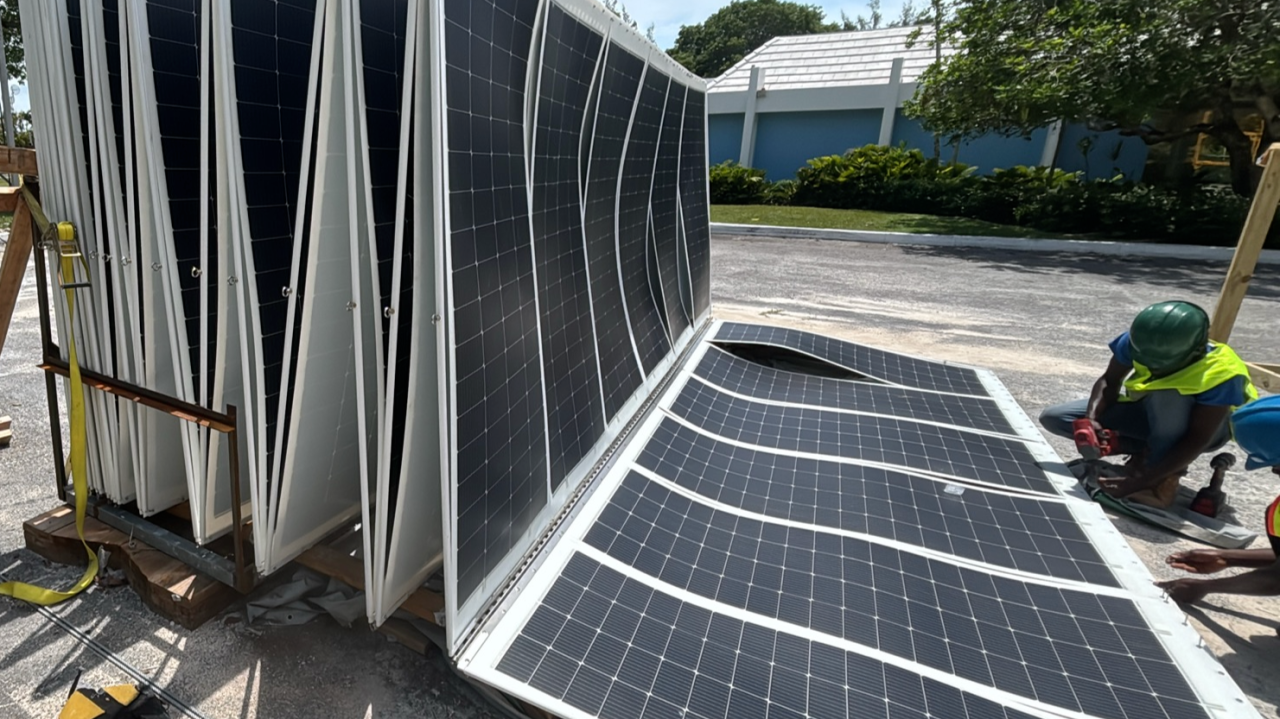
Sabal's solar panels have the best power to weight ratio in the world

Read full article

Sabal's solar panels have the best power to weight ratio in the world

How do you suspend 120 solar panels 12 to 18 feet in the air on a pair of cables?

Very carefully, of course.

Conventional framed solar panels are heavy. You might not think so just looking at it, but a conventionally framed 280W solar panel (anodized aluminum frame with a tempered glass front) typically weighs between 39 and 42 lbs (17.5 to 19 kg) for a standard 60-cell residential format. However, depending on the cell count, era of manufacture, and glass thickness, weights across the 280W class range from 28.5 lbs to 60+ lbs (13 kg to 27.5 kg).

At 28.5 lbs each, just 120 panels would weigh 1.5 tons. This is a significant weight to suspend high in the air, especially on a rotating system with intelligent dynamic wind response.

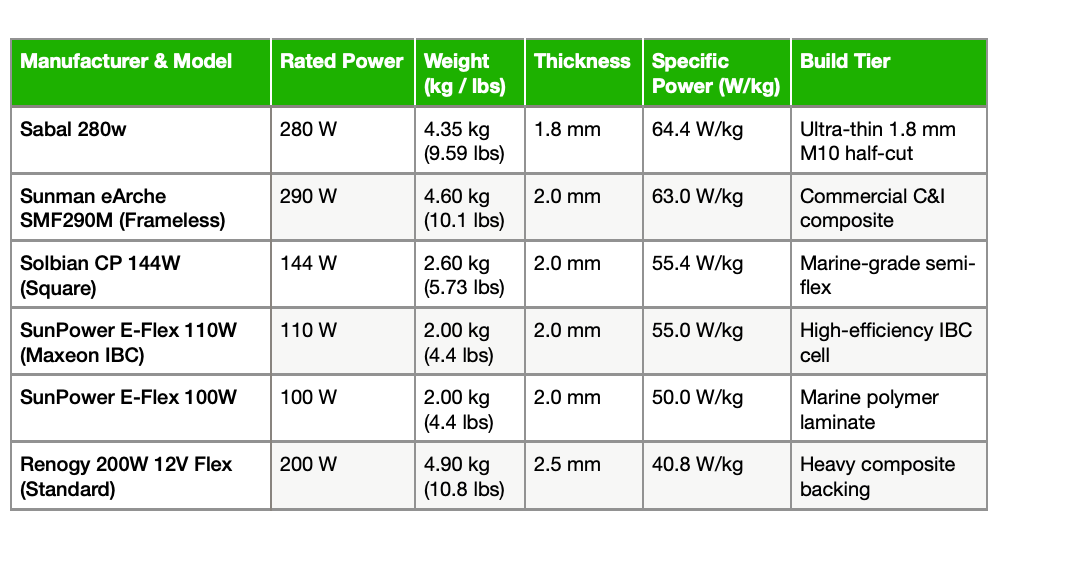
There are lighter solar panels, of course. Thin films weigh less, but produce much less power. CIGS technologies weigh less, but cost over $1,400 per panel. The Sabal 280w panel is the result of nearly a year's worth of work between our designers and the manufacturing experts. This is a hard earned value:

Comparison of solar panel power-to-weight ratios from the Sabal Energy article

If you think about it, power to weight ratios are not a critical success factor for panels. Sure, RV mounting is better if you don't have two panels that weight nearly 80lbs between them. But our constraints are specific: we want to minimize ground anchors and with that less surface area lost to concrete anchors, and the more weight we have to move around, the more expensive the conveyance and suspension hardware.

Still, 120 Sabal 280w panels weigh 1,200 lbs (0.6 tons), still not a feather weight. But it is light enough that we can create a storage structure that can sit on a reinforced post and handle 200 mph continuous wind. If it weighed more, this would not be economically possible.

With the help of our customers and investors we will be improving this performance even further. While the theoretical maximum for monocrystalline silicon is around 65w/kg, we are anticipating new substrates and materials that reduce panel weight further, meaning lower suspension, protection, and conveyance costs for our customers.

So how does a Sabal Solar Canopy work?

Sabal Energy

A short behind-the-scenes tour of how the Sabal Solar Canopy works

Read full article

So how does a Sabal Solar Canopy work?

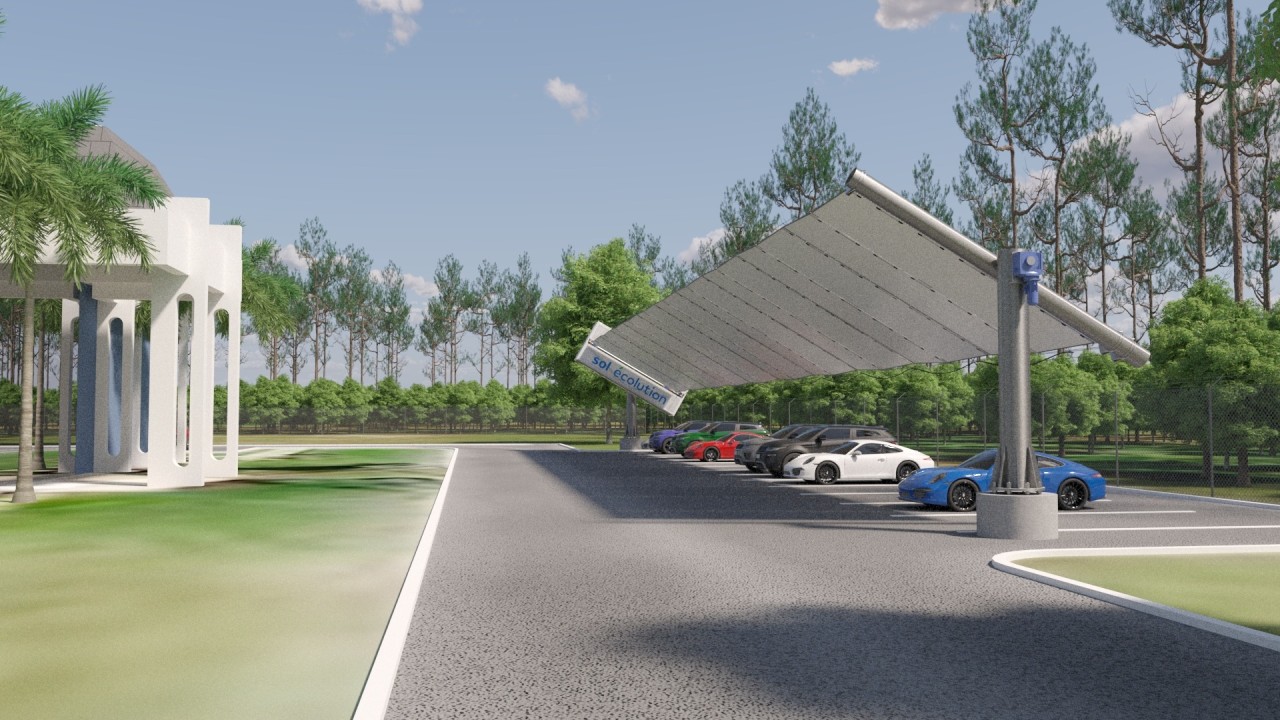
We built the Sabal Solar Canopy from concept to fabrication as a way to provide durable electrical power in built-environment public spaces. It is highly wind resilient, uses few post mounts, and has sufficient clearance to clear most vehicles (12 - 18ft). The 130ft system offers 33kW STC capacity using high efficiency monocrystalline panels.

The system has four major components: A main post, an opposing post, an opposing crossmember, and a panel container with the solar panel canopy folded up inside.

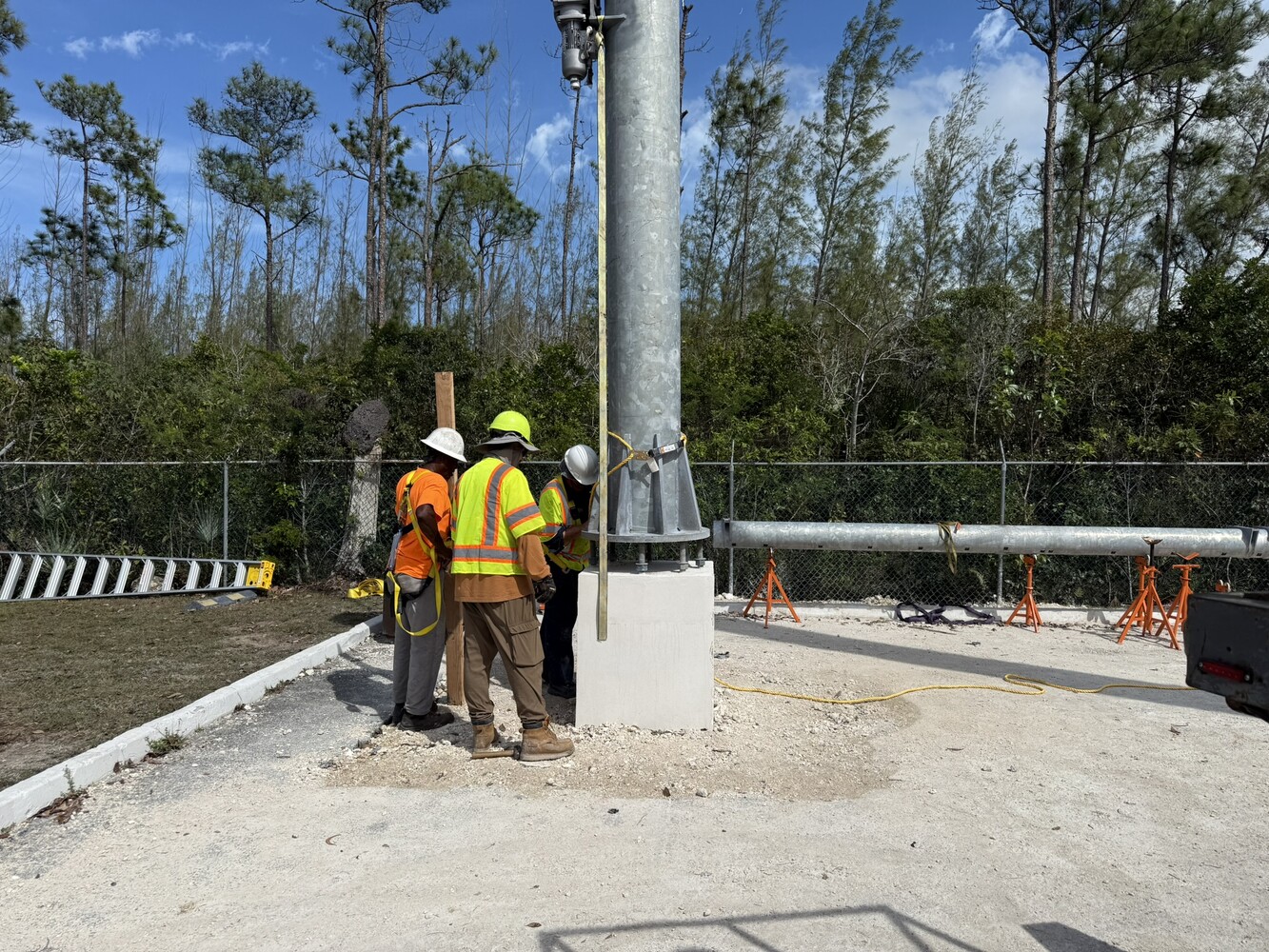
Each post is made of high strength steel 3/8" thick and 20" in diameter. It is a flanged system that uses J bolts embedded in concrete as deep as it needs to go. This is a conventional mounting system, used for utility poles all over the world.

Installers (Sky Overturf) putting up the Opposing Post

Both main and opposing posts have large, high torque, low speed motors on them that rotate the entire canopy a fraction of a degree at a time. These motors have super large crankcases and weigh more than 500 pounds each. In the picture above you can see the bottom of the opposing post tilt motor.

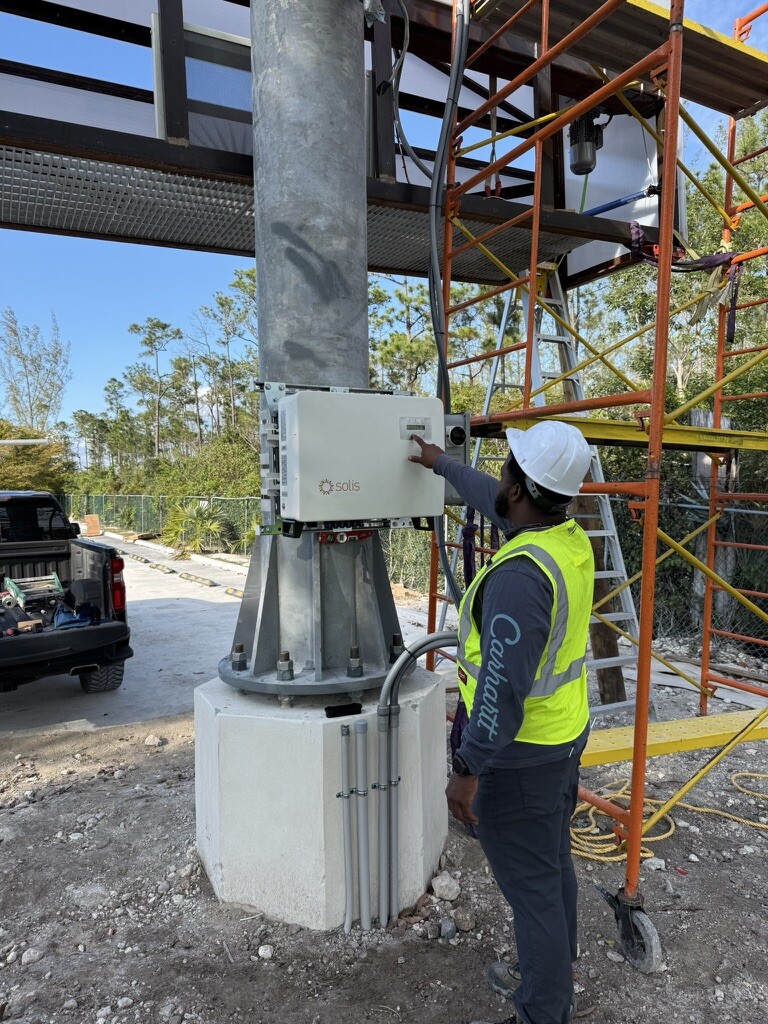
The Solar Panel Container is mounted on the main post. In the picture below, you can see the main post with the mounted container, and a 30kW three phase inverter mounted to the main post in the reverse position.

Jimi Thompson checking out the new Inverter

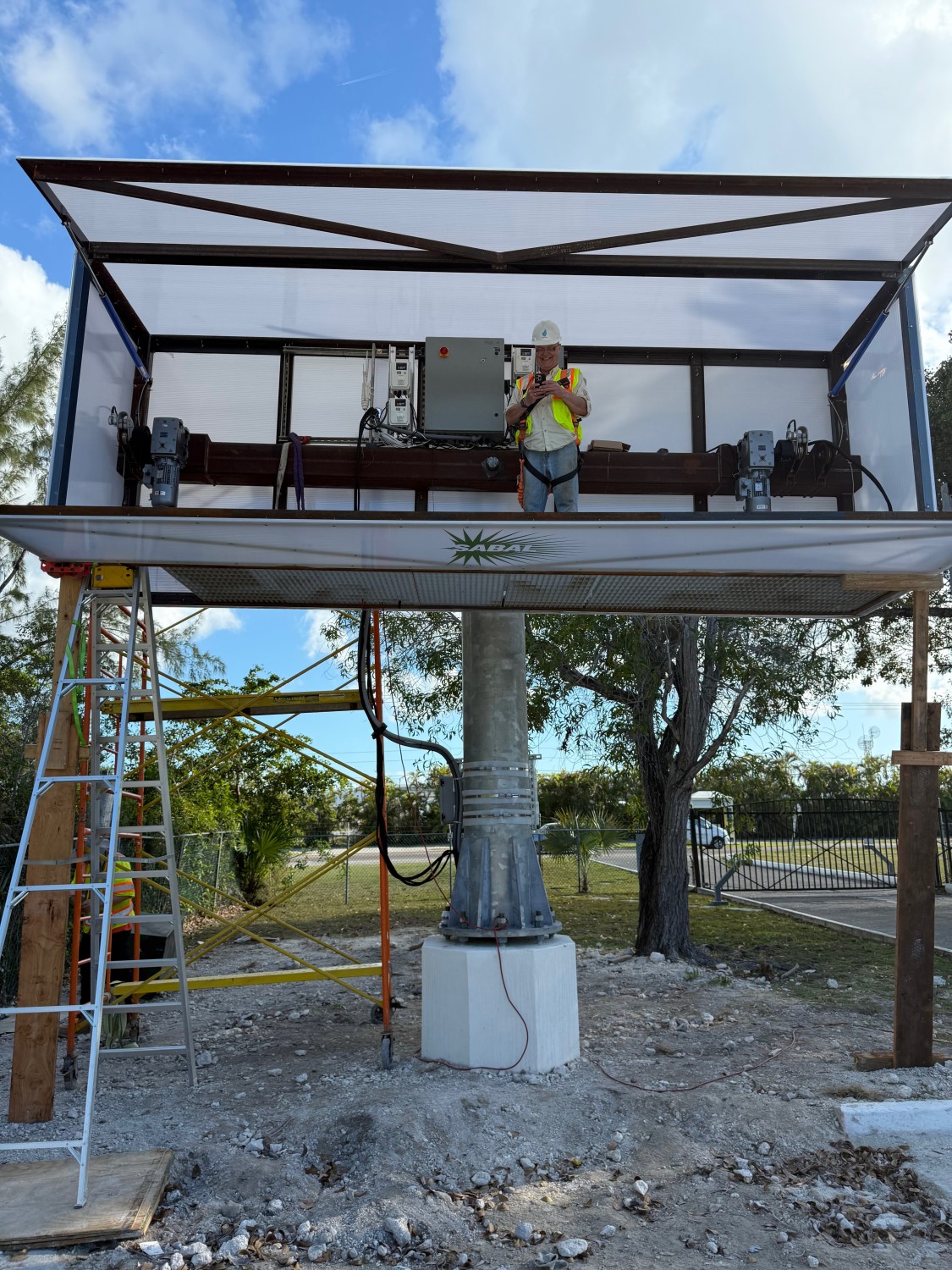
The inside of the solar panel container has a floor, an open grate so you can't get too comfortable in it.

There are two array motors mounted on either side that turn the cable suspension pulleys to fold and unfold the array (see below). In the center of the container, mounted to the back plane, are variable frequency drives that control the motors, a power management panel, and the control computer. The doors are controlled with 400lb actuators for opening and closing.

service gangway when the panels are unfolded

The array rows themselves are carefully spring-loaded so they have a slight bias in the direction of the fold when the array is pushed in or pulled out by the leading edge of the array. They don't lay completely flat and still have a 5 degree angle when unfolded. This has no impact on production, and the panels themselves have a prismatic coating that allows them to take in light rays at a much greater angle than conventional panels.

The single axis tracking is performed with the two large tilt motors that can rotate the canopy to a maximum of 90 degrees, but are limited to about 30 - 35 degrees in software. The control computer adjusts the angle about every 10 minutes or so during tracking and you'll hear the tilt motors kick in for just a second to move the shaft as the sun arcs across the sky.

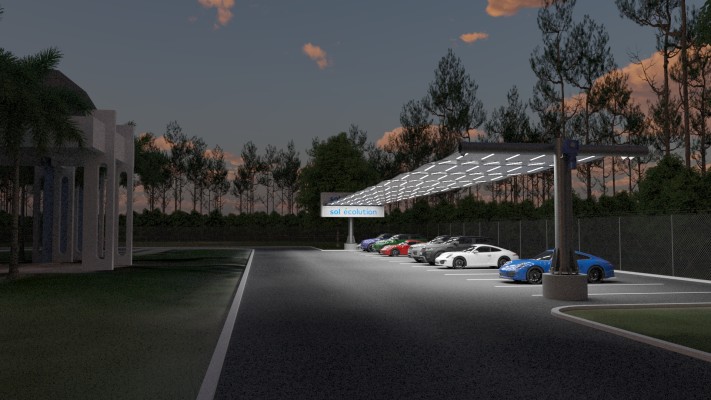
At night the area underneath the canopy is lit quite bright - much brighter than conventional parking lot lighting because of the white reflective surface of the panels.

Nighttime lighting
Nighttime lighting

The neat thing about the Sabal Canopy: only has two posts for a 130 foot length. You can string two canopies in series where the center post supports both opposing and solar container on one post, so that would have three posts every 260 feet in length. A 200kW parking lot power plant is held up by six posts! This minimizes the impact on lot utilization, simplifies installation, and reduces accident chances. The combination of low surface utilization plus 25% greater power production vs conventional canopies makes this a big winner for storm exposed areas.

Sabal Energy

How did we come up with this crazy idea?

In 2009 I became interested in the solar energy business. At that time, the idea of using parking lots for solar production was a relatively new idea, and there are strong subsidies in place to do so. It made sense: parking lots are built space, and you could increase the value per square foot by generating electricity in the same space where cars are stored. Since I was operating some factories in Torreon Mexico already for a different business, I decided to come up with some designs that could be manufactured there at a competitive cost. The result was 'ShadeMax', a fixed structure that was competitive (shown attached), but soon the solar subsidies dried up and the market dropped down to zero for these things. Along the way I met many interesting people, among them was Guilden Gilbert in the Bahamas who took a strong interest in the technology and we discussed it off and on over the years. Many years later Guilden was asked by a resort developer whether he had any good ideas for parking lot solar, as electricity prices were ever increasing and they were looking for some sort of energy cost control - was that something feasible? Guilden called me and challenged me to come up with something that would meet this need. It was clear that winds could get tough, and building codes already demanded 160mph wind resistance. Moreover, the aesthetics of putting lots of steel posts into the ground in a resort did not seem appealing. We had to come up with something that could generate the power, still open up to view the sky if needed, wasn't really ugly, and could survive winds over 160mph. The result is the Sabal Solar Canopy. The developer loved it, thought it was the best thing he'd ever seen. It received so much attention we were soon talking to many other people about this and to my disbelief received an order for one sight unseen. Clearly, this had some legs. The video attached is the first generation design that has some of the features the system does today. But it was the start of our journey, some four years ago!