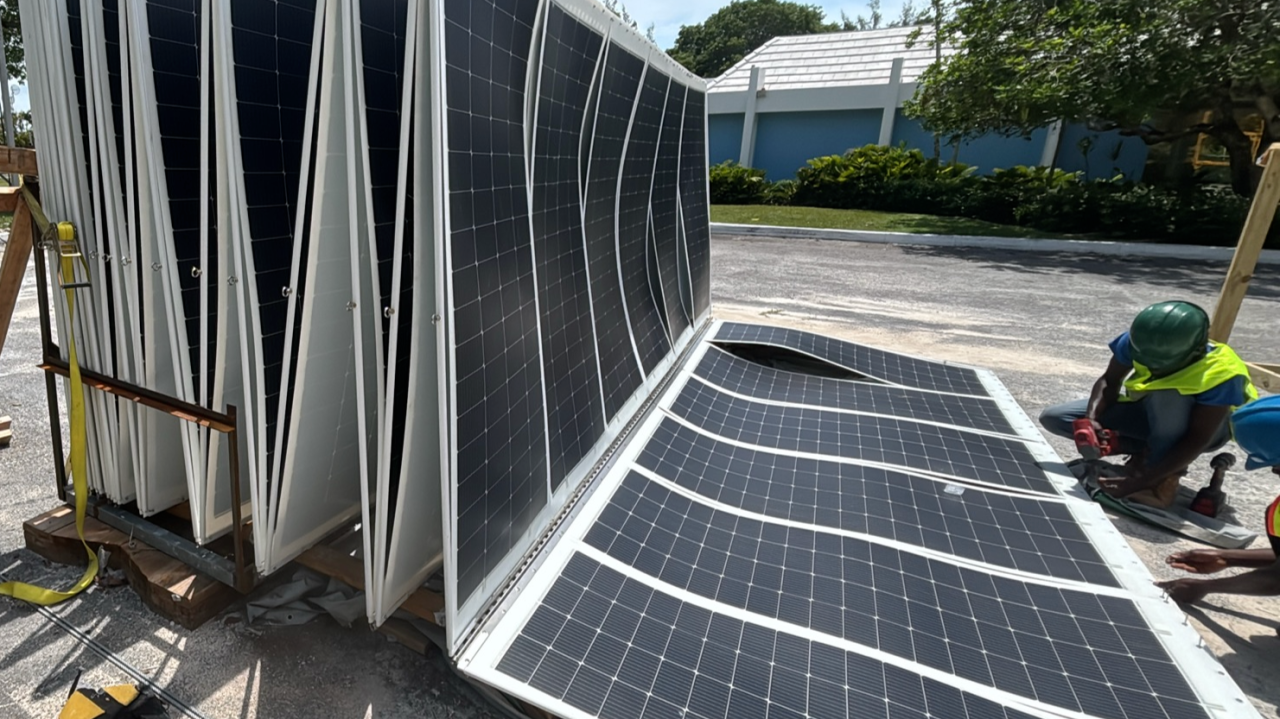
Sabal's solar panels have the best power to weight ratio in the world
How do you suspend 120 solar panels 12 to 18 feet in the air on a pair of cables?
Very carefully, of course.
Conventional framed solar panels are heavy. You might not think so just looking at it, but a conventionally framed 280W solar panel (anodized aluminum frame with a tempered glass front) typically weighs between 39 and 42 lbs (17.5 to 19 kg) for a standard 60-cell residential format. However, depending on the cell count, era of manufacture, and glass thickness, weights across the 280W class range from 28.5 lbs to 60+ lbs (13 kg to 27.5 kg).
At 28.5 lbs each, just 120 panels would weigh 1.5 tons. This is a significant weight to suspend high in the air, especially on a rotating system with intelligent dynamic wind response.
There are lighter solar panels, of course. Thin films weigh less, but produce much less power. CIGS technologies weigh less, but cost over $1,400 per panel. The Sabal 280w panel is the result of nearly a year's worth of work between our designers and the manufacturing experts. This is a hard earned value:
If you think about it, power to weight ratios are not a critical success factor for panels. Sure, RV mounting is better if you don't have two panels that weight nearly 80lbs between them. But our constraints are specific: we want to minimize ground anchors and with that less surface area lost to concrete anchors, and the more weight we have to move around, the more expensive the conveyance and suspension hardware.
Still, 120 Sabal 280w panels weigh 1,200 lbs (0.6 tons), still not a feather weight. But it is light enough that we can create a storage structure that can sit on a reinforced post and handle 200 mph continuous wind. If it weighed more, this would not be economically possible.
With the help of our customers and investors we will be improving this performance even further. While the theoretical maximum for monocrystalline silicon is around 65w/kg, we are anticipating new substrates and materials that reduce panel weight further, meaning lower suspension, protection, and conveyance costs for our customers.